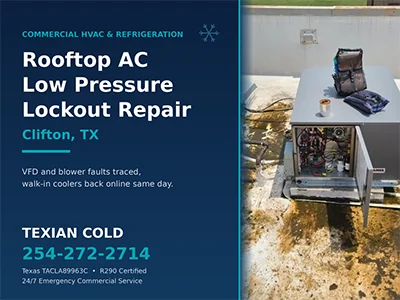
Rooftop AC Low Pressure Lockout in Clifton, TX: The VFD Was the Culprit
Near N Avenue G Clifton, TX 76634
August 4, 2026 — Clifton, TX
Two calls came in as one ticket from a Clifton restaurant last week: the kitchen air conditioning had quit cooling, and the walk-in cooler was tripping its breaker. Different systems, different failure modes, one very unhappy kitchen.
The rooftop unit turned out to be the more interesting of the two. It was locked out on low pressure — the classic signature of a refrigerant problem — but the refrigerant was fine. The actual cause was a drive that never spun the blower up to full speed.
A Low Pressure Lockout That Was Not a Refrigerant Problem
The rooftop unit serving the kitchen had shut down its second stage of cooling on a low pressure trip. On a packaged commercial unit, that safety exists to protect the compressor: when suction pressure drops below a set threshold, the control locks the stage out rather than letting the compressor run in a condition that will damage it.
Most operators — and plenty of technicians — hear “low pressure lockout” and immediately reach for gauges and a leak detector. That instinct is right often enough to be dangerous, because it means the other cause gets missed.
Suction pressure does not only fall when refrigerant is low. It also falls when there is not enough air moving across the evaporator coil. Less airflow means less heat arriving at the coil, which means less boiling refrigerant, which means lower suction pressure. A system with a perfect charge will trip a low pressure switch all day long if the blower is not doing its job.
The VFD Was Not Ramping to 100 Percent
Texian Cold lead technician Clay checked the airflow side before touching the charge, and found the variable frequency drive controlling the blower motor was not ramping to full speed. The unit was calling for stage 2 cooling and getting stage 1 airflow.
- Presenting symptom: kitchen rooftop unit locked out on stage 2, low pressure trip.
- Immediate cause: suction pressure falling below the safety threshold.
- Root cause: the VFD was not driving the blower to 100 percent, starving the coil of airflow.
The correction was mechanical and electrical rather than a parts swap. Clay adjusted the belt and reset the motor speed so the blower delivered its designed airflow, then reset the unit controls. Both stages came back online and the unit held cooling through the rest of the visit.
Worth noting for anyone running packaged equipment: a belt that has stretched, glazed, or been set to the wrong tension will quietly rob airflow long before anything trips. Pair that with a drive that is not commanding full speed and you get a system that looks like it has a refrigerant leak but does not.
Kitchen AC down or a cooler tripping breakers? Call 254-272-2714. We run commercial service across the Heart of Texas and we know what an afternoon of downtime costs a restaurant.
The Walk-In Cooler: A Wire That Had Rubbed Through
The second half of the call was electrical. The walk-in cooler was tripping its breaker, and the fault was inside the evaporator panel — a power wire had rubbed through its insulation and was shorting against the panel.
Evaporator sections are a common home for this failure. Fan motors vibrate continuously, panels get opened and closed for cleaning and defrost service, and wire runs shift a few millimeters at a time over the years until one of them finds a sharp edge. A breaker that trips on a walk-in cooler is not a nuisance to be reset — it is a live electrical fault the breaker is doing its job to interrupt.
Clay repaired the damaged wire and the cooler returned to normal operation the same visit.
What We Flagged for Follow-Up
Three findings on this roof were documented rather than repaired, and all three are costing this operator money right now:
- Flattened condenser coils. The fins on the rooftop condensers have been crushed by earlier work, which restricts airflow through the coil and drives discharge pressure up. High head pressure means higher amp draw, higher power bills, and shorter compressor life. Coil cleaning and fin repair are recommended for all rooftop equipment on this building.
- Missing drain vents. Neither rooftop unit has a vent tee installed close to its P-trap. Without one, the trap can siphon dry or hold water where it should not, which is how condensate ends up somewhere other than the drain.
- Stripped suction line insulation. Both walk-in suction lines have lost their insulation. Bare suction line in a Central Texas August absorbs heat the whole way back to the compressor, which the system then has to remove again. It is a pure efficiency loss and an easy one to fix.
None of these will shut a system down tomorrow. All of them show up on the power bill and in the service history, which is exactly the kind of thing a preventative maintenance program is built to catch before it compounds. Operators watching utility costs closely may also want to look at energy management options.
Commercial HVAC and Refrigeration Service Across the Heart of Texas
Whether it is a rooftop unit locking out on a safety, a walk-in tripping breakers, or a system that simply is not holding temperature the way it used to, we handle commercial HVAC repairs and refrigeration service for restaurants, convenience stores, medical facilities, and food operators across Central Texas. Our technicians work on Carrier, Trane, Lennox, York, Goodman, Daikin, and other major commercial brands, and we are factory authorized for Norlake and Master-Bilt.
Call Texian Cold at 254-272-2714 for same-day commercial service. Texas TACLA89963C licensed and R290 Certified.
Proudly serving Waco, Hillsboro, Whitney, Temple, Gatesville, Mexia, Clifton, Meridian, Groesbeck — and surrounding Central Texas communities.
Commercial Refrigeration & HVAC Repair
Serving Waco, Temple, Hillsboro, Whitney, Gatesville, Mexia, Groesbeck, Clifton, Meridian — and surrounding Central Texas communities.
Texas TACLA89963C licensed • R290 Certified • Factory authorized for Norlake & Master-Bilt • 25+ years in the field.
Same-day commercial service for restaurants, retail, medical facilities, and food operators across the Heart of Texas.