Bypassed Safeties and Grounded Compressors on Waco Rooftop Units
Near I-35 N Frontage Rd, Waco TX 76705
August 7, 2026 — Waco, TX — Updated September 28, 2026
Most commercial HVAC calls start with a symptom. This one started with a question: why does a building with two packaged rooftop units keep losing cooling when both units still appear to be running?
The answer, in this case, was that neither unit was really running the way it was designed to. Over time, someone had kept them limping along by disabling the very devices built to shut them down. That is a common story on aging rooftop equipment in Central Texas, and it is worth understanding — because the repair bill is never the expensive part. The liability is.
Two Packaged Units, Two Grounded Compressors
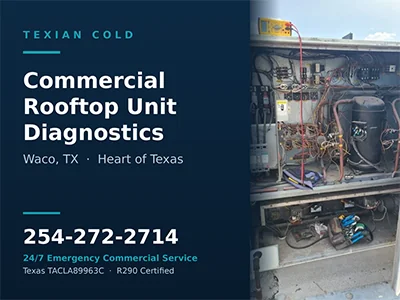
The diagnostic covered two packaged rooftop units serving a Waco restaurant — one AAON and one Trane. Both had a compressor that was electrically grounded and already disconnected before we arrived.
A grounded compressor means the motor windings have failed insulation and are shorting to the compressor housing. It is not a repairable condition. Once a compressor grounds, it either gets replaced or the circuit stays dead. Disconnecting it keeps the breaker from tripping and lets the rest of the unit keep operating — at reduced capacity, with the building never quite getting cool.
On the AAON, the failed compressor was the stage 2 unit, which means the system lost its high-demand capacity precisely when the August load needed it most. The Trane was in the same condition, and had additionally shut down on smoke detection, which our technician reset before continuing the inspection.
What We Found in the Control Panels
The electrical side is where this job stopped being a routine capacity problem. Across the two units, the inspection documented:
- Three of four relays bypassed. Control relays had been jumpered out rather than replaced.
- Transformers wired directly together. An incorrect configuration that affects how the control circuit powers and sequences the unit.
- Safeties cut loose. On the Trane, protective devices had been disconnected from the circuit entirely.
- High and low limit safeties requiring replacement. The pressure protection that stops a compressor before it destroys itself.
- A seized blower motor on the AAON, non-functional and not moving air.
Every one of those changes has the same short-term logic behind it: the unit would not run, so someone made it run. And every one of them removes a protection the manufacturer installed for a reason.
Why a Bypassed Safety Is More Expensive Than the Part It Replaced
A high-pressure switch costs a fraction of a compressor. A low-pressure switch costs less than a refrigerant recovery and recharge. When those switches are jumpered out, the unit no longer has any way to protect itself — it will run into a fault condition until something mechanical fails instead.
That is very likely part of how two compressors ended up grounded in the same building. Compressors do not usually fail at the same time by coincidence. They fail together when the conditions that damage them are shared, and unprotected operation is one of the fastest ways to get there.
There is also an insurance and code dimension that operators rarely hear about until it matters. Defeated safety devices on commercial equipment can complicate a claim after an equipment fire or a system failure, and they are exactly the kind of finding that turns a covered loss into a contested one.
The Combustion-Side Finding That Cannot Wait for Winter
The most urgent item on this job has nothing to do with cooling. The AAON unit’s heat exchanger showed rusting areas — the early stage of the failure mode that eventually lets combustion gases cross into the supply air stream.
A gas-fired rooftop unit keeps two air streams strictly separated: the combustion products that go up the flue, and the conditioned air that goes into the building. The heat exchanger is the physical wall between them. When corrosion perforates that wall, flue gases — including carbon monoxide — can be drawn into the duct system and delivered straight to the dining room.
The unit is in cooling season right now, so the burners are idle and the risk is not active. That is exactly why this is the right moment to address it. Waiting until the first cold snap means discovering a compromised heat exchanger on the day you need heat, with a full dining room and no good options.
Not sure what has been done to your rooftop equipment over the years? Call 254-272-2714. Texian Cold runs 24/7 commercial HVAC repair across the Heart of Texas, and a documented diagnostic tells you what you actually own before it fails on a Friday night.
Airflow and Cleaning Items
Rounding out the inspection were several conditions that quietly cost efficiency and shorten equipment life:
- A vortex blower wheel needing cleaning — accumulated debris on blower wheels reduces airflow and unbalances the assembly
- A dirty evaporator coil on the Trane, restricting heat transfer
- A dirty condenser coil, raising head pressure and compressor load in 100-degree ambient
None of these are emergencies on their own. Together, they explain a meaningful share of why both systems were struggling before the compressors ever failed, and they are precisely what a preventative maintenance program is designed to catch on a schedule instead of during a breakdown.
Why This Estimate Comes With a Caveat
We are preparing a full repair estimate for both units. It comes with an honest warning attached, and operators deserve to hear it before work begins: when this much of a control circuit has been bypassed, additional faults are likely to surface once the electrical is restored to correct operation.
That is not a hedge. It is how these jobs actually go. Bypassed relays and disconnected safeties mask the conditions underneath them. Reconnect a low-limit safety and it may start tripping immediately — not because the new part is bad, but because it is finally reporting a real fault that has been running unchecked for months.
The alternative is worse. Quoting a clean number, restoring the circuit, and then presenting a surprise second invoice is how operators lose trust in contractors. We would rather set the expectation up front and be wrong about it than the reverse.
Case Update: A Rooftop Safety That Did Its Job
A September call to another Waco restaurant showed the other side of the same story. The building was running hot, and the packaged rooftop unit — a Carrier WeatherMaster — kept shutting its compressor down on high pressure.
This time the safety was connected and doing exactly what it was built to do. The cause was a detail left behind by the previous maintenance contractor: an access panel on the unit had not been secured. A packaged unit depends on its panels to force outdoor air through the condenser coil. With one left open, the condenser fan pulled air through the easiest path instead, bypassing the coil. The unit could not reject heat, head pressure climbed, and the high pressure switch tripped the compressor.
Clay secured the panel and the unit went back to normal operation. No parts, no refrigerant, no second visit.
The lesson runs in both directions. A tripping safety is not the problem — it is the unit reporting one. Jumper it out and the compressor pays for it. Find the cause, and sometimes the fix is as simple as a fastened panel. It is also worth a quick look after any maintenance visit: every panel on a rooftop unit should be closed and secured before the technician leaves the roof.
Case Update: A Robinson Walk-In With Its Safeties Cut Out
Eleven days later, a Robinson restaurant showed what bypassed safeties look like on the refrigeration side. The walk-in cooler was not holding temperature, and the rooftop condensing unit serving it was not running at all.
The contactor was pulled in and calling for cooling, but the compressor was sitting off on its internal thermal overload. The cause was on top of the unit: the condenser fan motor had burned out. Without condenser airflow, head pressure climbs fast, and that is exactly the condition a high pressure safety exists to catch. On this unit it had been cut out of the circuit by others, along with the fan cycle control that manages condenser fan operation. With both gone, the only protection left was the overload built into the compressor itself.
Clay replaced the failed parts and put the protection back:
- A new 1/6 HP condenser fan motor with a matching run capacitor
- A new fan cycle pressure control, wired back into the circuit
- A new dual pressure control, after the compressor began short cycling on a low pressure switch that had also failed — restoring both high and low pressure protection in one device
The unit was rewired, back on line, and cooling before Clay left the roof. This compressor survived its unprotected run. The two in the August diagnostic did not. For restaurants running a walk-in cooler off a rooftop condensing unit, the same question applies as on a packaged AC unit: are the safeties actually connected?
What Central Texas Operators Should Take From This
If you have inherited rooftop equipment — through a building purchase, a lease, a change in service contractors, or simply enough years that nobody remembers what was done — a documented diagnostic is worth more than a service call. Ask specifically whether any safeties or relays have been bypassed, and get the answer in writing.
Ongoing visibility helps too. Remote monitoring catches temperature and runtime drift before it turns into a failure, and energy management often surfaces a struggling unit through its power draw well before anyone in the building notices the air is warm. When equipment finally reaches the end of the line, planning a commercial HVAC replacement on your schedule beats an emergency changeout in August every time.
Texian Cold is a licensed commercial contractor — Texas TACLA89963C, R290 Certified — and our technicians work on AAON, Trane, Carrier, Lennox, York, Rheem, Goodman, Daikin, and other major commercial brands.
Need a straight assessment of your rooftop units? Call 254-272-2714. We serve commercial
Commercial Refrigeration & HVAC Repair
Serving Waco, Temple, Hillsboro, Whitney, Gatesville, Mexia, Groesbeck, Clifton, Meridian — and surrounding Central Texas communities.
Texas TACLA89963C licensed • R290 Certified • Factory authorized for Norlake & Master-Bilt • 25+ years in the field.
Same-day commercial service for restaurants, retail, medical facilities, and food operators across the Heart of Texas.